They called it random.
They called it irrelevant.
That was the official reaction — clipped phrases, tidy dismissals, the kind that close doors instead of opening conversations.
Bruce Springsteen heard something else.
He called it “Streets of Minneapolis.”
At first, the title alone raised eyebrows. Minneapolis isn’t the usual shorthand for American mythology. It’s not the coastal symbol of power, not the polished postcard city of triumph. But for Springsteen, cities have never been backdrops. They’re living archives — places where history leaves fingerprints on sidewalks, where silence can be louder than speeches.
Fans noticed immediately. This wasn’t a casual naming. This wasn’t random.
Minneapolis carries weight. It carries memory. It carries questions the country still hasn’t answered.
Online, discussions began quietly — a few comments here, a thread there. Listeners dissected lyrics, tones, pauses. Some heard grief. Others heard accusation. Many heard something more unsettling: restraint. A refusal to explain itself. A song that doesn’t shout, but doesn’t look away either.
That restraint may be exactly what makes people uncomfortable.
Because when art is loud, it’s easy to dismiss. When it’s subtle, it’s harder to ignore.
The White House, officially, says there’s nothing to see here. No message. No meaning. Just another piece of music, overanalyzed by fans hungry for controversy. But that response has only fueled speculation. If it’s irrelevant, why rush to label it so? If it’s random, why does it feel so precise?
Springsteen has built a career on chronicling the lives left out of press briefings. His songs linger on factory towns, forgotten streets, people who don’t make headlines unless something goes terribly wrong. Naming a song after Minneapolis isn’t just geographic — it’s symbolic. It points to a moment, a rupture, a reckoning that many would prefer to repackage as “resolved” and move past.
Fans aren’t letting it go.
Some argue the song is a quiet memorial. Others hear it as a warning — that the conditions which led to past unrest haven’t disappeared, only faded from the news cycle. A growing number see it as a mirror held up to power itself, reflecting not outrage, but avoidance.
What’s striking is how divided the reaction has become. To some, the song is “nothing.” To others, it’s precisely because it refuses to declare itself that it matters. It doesn’t tell listeners what to think. It asks them to sit with discomfort, to connect dots themselves.
And that may be the thing institutions fear most.
Because when art gives answers, it can be managed.
When it asks questions, it spreads.
“Streets of Minneapolis” doesn’t demand attention — it earns it. It drifts into the background and stays there, resurfacing when least expected. In a time of constant noise, that kind of persistence is dangerous. It seeps. It lingers. It makes forgetting difficult.
Whether Springsteen intended a political statement or not almost feels beside the point now. The conversation has escaped him — and that’s how cultural moments are born. Not from declarations, but from shared unease. From the sense that something is being talked around instead of talked about.
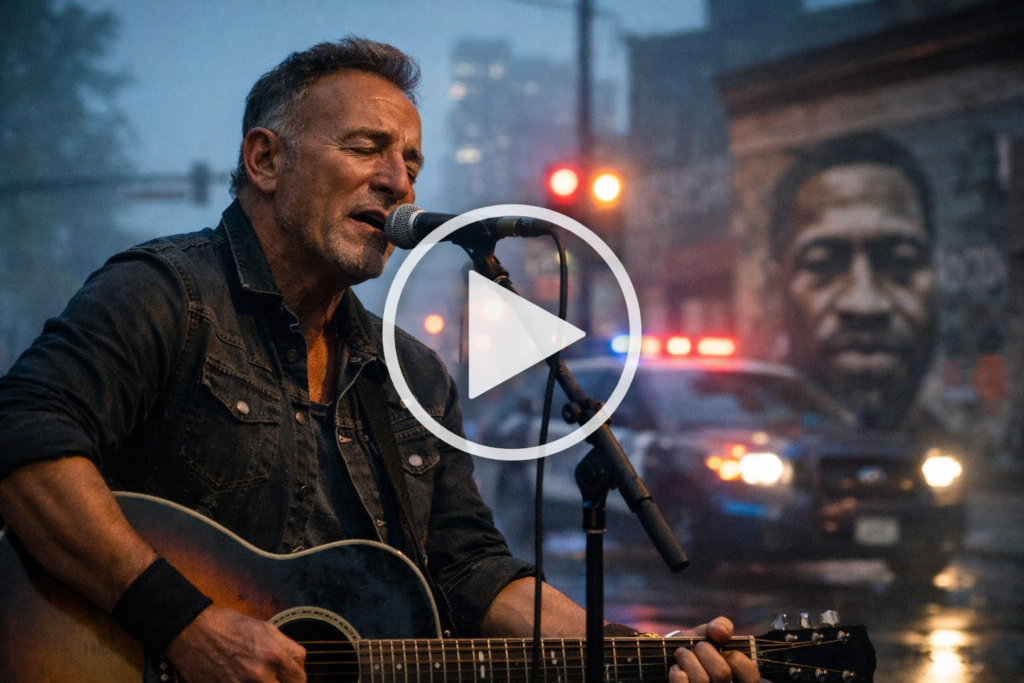
So fans keep listening.
They keep debating.
They keep asking why a song dismissed as “irrelevant” refuses to fade.
And maybe that’s the real question this moment leaves us with:
If a song can be ignored so forcefully, what does that say about what it’s touching — and who doesn’t want to feel it?