How One Olympic Fall Sparked a Powerful Reminder About Resilience
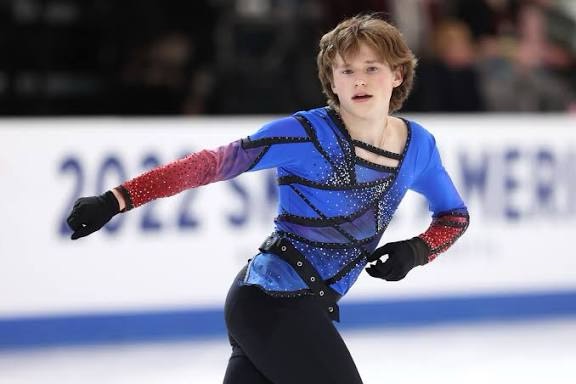
The arena was electric with expectation. Every eye was fixed on 21-year-old Ilia Malinin — the prodigy known worldwide as the “Quad God.” With a reputation built on gravity-defying jumps and fearless technical mastery, he carried not just his own dreams onto the Olympic ice, but the weight of a sport’s belief in him.
Then came the unthinkable.
A performance that was meant to solidify greatness instead unraveled in real time. A misstep. A fall. Then another. The silence inside the arena was deafening. Fans who had arrived ready to witness history suddenly found themselves watching heartbreak.
In elite figure skating, margins are razor thin. One imperfect moment can redraw an entire narrative. And for Malinin, this was more than just a flawed skate — it was a collision between expectation and reality on the sport’s biggest stage.
But what happened next is what truly captured the world’s attention.
A photograph began circulating online: Malinin wrapped in a quiet, emotional embrace with fellow skater Mikhail Shaidorov. There were no cameras flashing in his face in that instant. No medals, no rankings, no commentators. Just two athletes — one visibly shattered, the other offering silent solidarity.
The image spoke louder than any scoreboard ever could.
Amid the heartbreak, Olympic champion Madison Chock offered words that cut through the noise and reframed the moment entirely:
“This moment does not define you — your heart does.”
In a sport obsessed with precision, Chock’s message was a reminder of something far deeper than technical scores. Championships measure performance. They do not measure character.
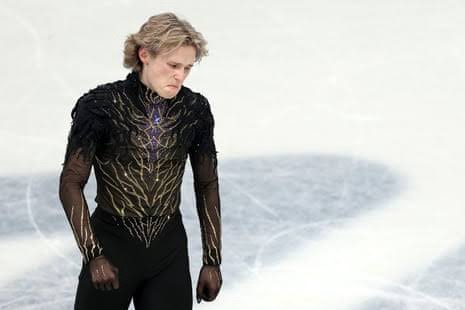
For Malinin, being labeled the “Quad God” has been both a badge of honor and an immense burden. With innovation comes expectation. With brilliance comes scrutiny. And when you are celebrated as nearly untouchable, any stumble feels magnified.
But resilience is not built in flawless victories. It is forged in visible falls.
The greatest athletes in history are not those who never falter — they are the ones who rise again under the harshest spotlight. Michael Jordan missed crucial shots. Simone Biles stepped away from competition to protect her well-being. Legends across sports have endured moments that seemed, at the time, like defining failures.
Yet none of those moments defined them.
What defines greatness is response.
In the hours following the performance, the narrative began to shift. Instead of focusing solely on mistakes, conversations turned toward courage — the courage it takes to compete when expectations are sky-high, the courage it takes to face the media afterward, and the courage it takes to return to the ice again.
Malinin’s journey is far from over. At 21, his technical ceiling remains astonishing. But perhaps this chapter — painful as it was — may become one of the most important in shaping his legacy.
Because sport, at its core, is not just about medals. It is about humanity under pressure. It is about vulnerability, perseverance, and the quiet strength found in community — sometimes in the form of a teammate’s embrace.
Madison Chock’s words resonate beyond figure skating. They speak to anyone who has stumbled publicly. Anyone who has carried expectations too heavy to hold. Anyone who has felt, even for a moment, that one failure might overshadow everything they’ve worked for.
Watch interview : https://youtu.be/GDDaHydUPDU?si=Y9xQKL2jutaxBbio
“This moment does not define you — your heart does.”
In the end, that may be the true victory.