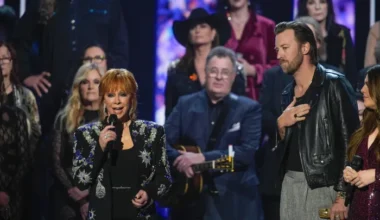
When Lee Ann Womack released “Never Again, Again” in the 1990s, she gave country music one of its most quietly devastating heartbreak ballads — a song rooted in pain, reflection, and emotional survival. Decades later, that same song found new life in a moment no one could have predicted, when American Idol contestant Hannah Harper stepped onto the stage and made it her own.
From the first line, Hannah’s performance carried a fragile honesty that immediately drew listeners in. She didn’t oversing or attempt to replicate the original. Instead, she allowed the story to unfold naturally, revealing emotion in its most vulnerable form. Her voice trembled at just the right moments, not from uncertainty, but from connection — the kind that can’t be manufactured.
The performance left viewers visibly moved. Social media quickly filled with reactions from fans who described the moment as “chilling,” “deeply personal,” and “unforgettable.” But the reaction everyone was waiting for came from the woman who lived the song first.
When Lee Ann Womack finally spoke, her response was simple — yet incredibly powerful.
“I’m a fan.”
Those words alone were enough to send waves through the country music community. Rather than drawing comparisons or guarding the legacy of a deeply personal song, Womack embraced Hannah’s interpretation with warmth and sincerity. She praised the vulnerability and quiet strength woven into the performance, acknowledging the courage it takes to carry someone else’s emotional story while making it truthful to your own.
Womack also reflected on what it means to hear your past echoed through a new voice. For any songwriter, those lyrics are more than words — they are lived experiences. Hearing them return years later, shaped by another artist’s perspective, can be both surreal and deeply moving.
Fans who had already been touched by Hannah’s performance said Womack’s reaction made the moment even more meaningful. It wasn’t just approval — it was recognition. It was one artist seeing herself in another, across time and experience.
Moments like this remind us why music endures. Songs don’t belong to just one era. They evolve, finding new meaning with each voice brave enough to carry them forward.
And in that moment, as Lee Ann Womack listened to Hannah Harper sing “Never Again, Again,” the past and present met — not in comparison, but in connection.