There are concerts you enjoy.
And then there are concerts that feel like time itself has paused to listen.
The Bob Dylan 30th Anniversary Concert Celebration was one of those rare nights. It wasn’t built on spectacle or flash. There were no fireworks, no overblown theatrics. What filled the room instead was something heavier — reverence, history, and the quiet awareness that everyone present was witnessing something that would never happen quite the same way again.
At the center stood Bob Dylan — not trying to relive the past, not trying to prove anything. His voice, textured by decades, carried the weight of experience. When he sang, it wasn’t nostalgia. It was reflection. Every phrase sounded lived-in, every word shaped by time.
But what transformed the evening from tribute to legend was the gathering around him.
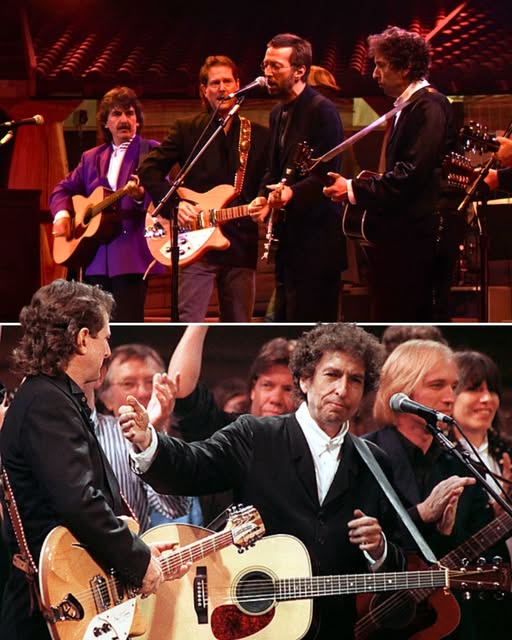
When the opening chords of “My Back Pages” began, the stage slowly filled with giants.
Roger McGuinn stepped forward first, his jangling tone instantly recognizable. As the voice behind The Byrds’ defining version of the song, McGuinn didn’t just perform it — he brought it home. His delivery carried clarity and gratitude, like a bridge connecting the song’s folk origins to its rock legacy.
Then came Tom Petty, singing with open sincerity. Petty had always possessed that rare ability to sound both grounded and soaring at the same time. That night, he didn’t overreach. He honored the lyric, letting its wisdom breathe.
Neil Young followed with a different energy — restless, burning, almost defiant. His voice cracked in places, but that vulnerability only made it stronger. Young didn’t polish the song; he wrestled with it, reminding everyone that great music isn’t meant to sit still.
Between verses, Eric Clapton let his guitar speak in soft, fluid phrases. His playing shimmered rather than shouted, guiding the performance gently forward. Every note felt intentional — a conversation rather than a solo.
And then there was George Harrison. Calm. Centered. Almost luminous in his restraint. Harrison’s presence seemed to hold the entire moment together. His voice carried quiet wisdom, and his melodic touch added grace to a stage already heavy with greatness.
Individually, each of these artists could command an arena. Together, they chose something rarer: humility.
When the chorus arrived — “Ah, but I was so much older then, I’m younger than that now” — six voices rose as one. It was not competitive. It was not showy. It was unified. The line, already powerful on record, took on new meaning sung by men who had truly lived its paradox. Youth, age, growth, regret, rediscovery — it was all there, layered into harmony.
In that moment, the performance stopped being a tribute to Dylan. It became a meditation on time itself.
The beauty of the night was not just in the star power, but in the respect. No one tried to dominate. No egos clashed. The stage felt less like a spotlight and more like a circle — artists honoring the songwriter who had shaped them, and in turn, the music that shaped generations.
Decades later, the performance continues to resonate. Millions return to it, not for nostalgia alone, but for what it represents: a fleeting alignment of talent, humility, and shared legacy. It reminds listeners that songs don’t age — they deepen. They gather new meaning as the people singing them gather new miles.
Rock history is full of iconic moments. But only a handful feel almost sacred.
“My Back Pages” at Dylan’s 30th anniversary celebration wasn’t just a highlight. It was a reminder of what can happen when legends stand side by side — not to outshine one another, but to serve the song.
Six artists.
One microphone.
And a chorus that still echoes, long after the lights went down.