By the time Ilia Malinin reached the final stretch of his Olympic free skate in Milan, the result had already slipped from his grasp. What remained was not shock, nor panic — but the quiet recognition that something long held and fiercely guarded had vanished in the space of four and a half unraveling minutes.
For nearly three years, Malinin had ruled men’s skating not merely as a champion, but as a force of nature. The “Quad God.” The architect of jumps others still treated as myth. Programs built like equations. Land the impossible early, and the rest would fall like dominoes. His dominance had been less about defeating rivals and more about redefining what rivalry meant.
Fourteen straight victories. A technical frontier pushed beyond imagination. Like Simone Biles in gymnastics, his greatest opponent had often seemed to be himself.
And then came the night when everything bent.
The axel that was meant to detonate the program popped harmlessly. A combination unraveled. A fall clattered against the ice where recovery once lived. Another jumping pass slipped away. What had once been controlled detonation folded inward into something chaotic and human. By the final pose, his coach and father could only turn away.
The Olympics have a way of compressing destiny into seconds. “The pressure is unreal,” Malinin would later say, repeating the word like a mantra. Pressure is not abstract in a sport built on muscle memory — it is physical. It speeds time. It steals instinct. It makes the familiar feel foreign.
He described the moment before his starting pose — memories rushing in, years of sacrifice arriving all at once. “It just felt so overwhelming,” he admitted. “I didn’t really know how to handle it.”
And while Malinin wrestled with the collapse of expectation, another skater seized the stillness.
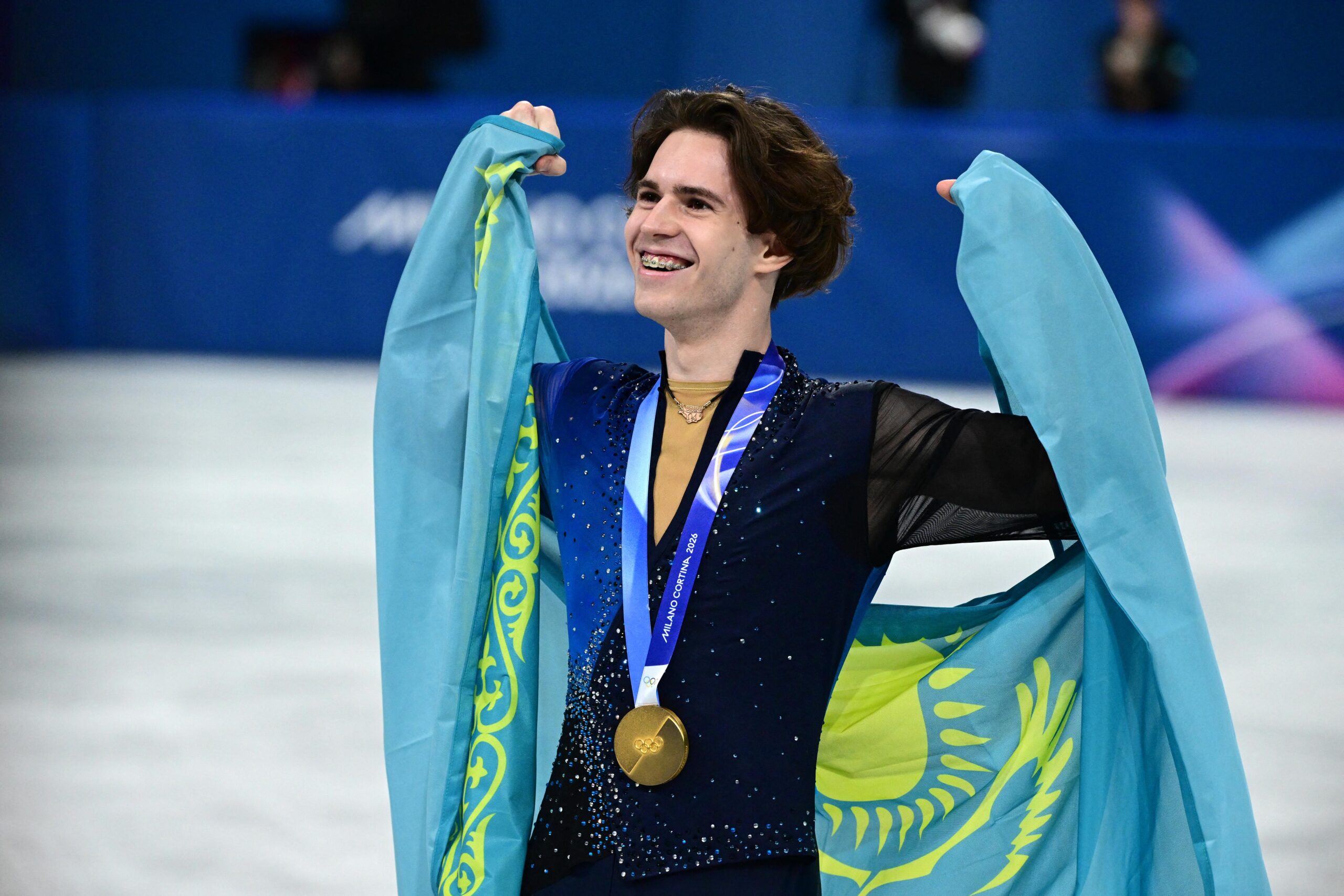
Mikhail Shaidorov entered the ice without mythology attached to his name. Fifth after the short program. Quiet. Unburdened. What followed was not revolutionary — it was relentless. Five quads. Clean landings. No deductions. No tremor in the edges. Where Malinin reached for the outer limits of possibility, Shaidorov mastered survival.
The gold went to Kazakhstan. Outside the arena, fans sang in the rain long past midnight, celebrating a national hero forged not in spectacle, but in steadiness.
The contrast felt philosophical. Malinin represents skating’s horizon — maximum risk, maximum difficulty, the sport as future tense. Shaidorov embodied its oldest truth: the skater who survives their own program often wins.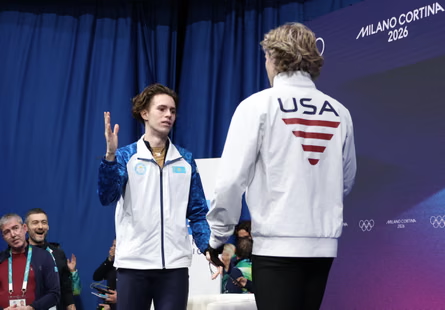
And yet, the most powerful moment of the night came not in the scoring, but afterward.
Malinin, eyes red and still shining with the sting of defeat, did not retreat to the tunnel. He crossed the ice. He pulled Shaidorov close. Cameras caught him speaking softly — words not meant for broadcast, but for honor. Witnesses say he congratulated him sincerely, acknowledging the strength and fearlessness of the performance.
Heartbreak remained in his expression. But so did respect.
It was raw. Unscripted. A reminder that even in collapse, character can endure.
The Olympics care little for momentum or mythology. They measure only what happens within one narrow window of time. For the Quad God, that window closed too quickly to adjust.
But this will not be the story that defines him.
He leaves Milan still the most technically gifted skater of his generation, still the architect of what the sport may become. The road to 2030 stretches long before him. Redemption is patient.
Friday night was cruel. It was chaotic. It was human.
And in the quiet embrace between rivals, it was beautiful.